Wednesday, 23 September 2015

Deconstruction of film posters


Avatar:
- The audiences eyes are diverted to all the colours on the poster and bold images such as the avatars eyes, the sun and the bold title, this done by using 'The golden rule'.
- The title is different as it doesn't use the stereotypical black font, which makes it stand out. It also reflects the sic-fi genre by giving it a futuristic look. 
- By saying it is available in 3D will draw in a wider range of audiences.
- The antagonist is gown through hi facial expressions as he is portrayed to be heroic and so he'll have an important role in the film.

I am Legend:

- The title is bold and white which makes i stand out from the background.
- The colour scheme is mainly black white ties in to the title, 'the dark knight'
- The title is positioned away from the centre to distant the audiences attention from the image, 'the golden rule'.
- At the bottom it tells you when the film is realised which gets the audience more interested.
- The iconic batman costume is used to increase the fan base as it will attract the attention of older generations.


The dark knight rises: 
- The bold title of the actors name 'Will Smith' draws the audiences attention to the poster as he is well know and has a large fan base.
- Will Smith is the largest figure on the poster and this shows his importance.
- By saying 'he is not alone' draws the audiences attention further s they will be wondering what else is going to be in the film.
- The over-turned and destroyed buildings suggests the films genre is action. Additionally from the mise-en-scene of the gun, this emphasises the edginess for upcoming.
- The background image comprises of a orange/yellow sky which symbolises danger and death. 


Monday, 21 September 2015

Deconstruction of St Trinians Trailer

Location:
- The location of the trailer is calm and peaceful boarding school until war breaks out after 10 seconds after a desk falls out of the window, this links in with Todorov's narrative theory that a narrative will have equilibrium and disequilibrium.  
- There are 2 different locations in the first 10 seconds to show as much action as possible.
- The audience is immediately introduced to the school to show that the film would be located there for a magority of the film.
- The trailer shows that it is set in London due to the famous landmarks such as the national gallery in Trafalgar Square, this means that the film can have a global audience.

Editing:
- Split screen- this is a common use of editing used in teen dramas to introduce a selection of charters in one shot, this is used in such films like mean girls.
- Fast cuts are used to get as much information in the trailer as possible.
- Additionally slow pace is used to allow the audience to connect with the characters or allow a joke.
- Comical scenes in the film are edited into the trailer to get the audience excited for the film and for the genre to be understood.
- Montages are used to show as much footage and action as possible.

Mise-en-scene:
- Their uniforms are customised by each character to sell the characters more and to show their personalities.
- There are a lot of characters in one room to show the closeness in their relationships.
- Old fashioned school-chalk boards-old building- to show how times have changed compared to modern schools new.
- Skulls & red ink which connotes with blood and police.
- Typography is uneven and scribbly which symbolise childlike behaviour.
- The classy car represents the wealthy character, the next shot shows a burning old car which conveys the contrast in classes.
                           

Sunday, 20 September 2015

Deconstruction of mise-en scene in My Mad Fat Diary


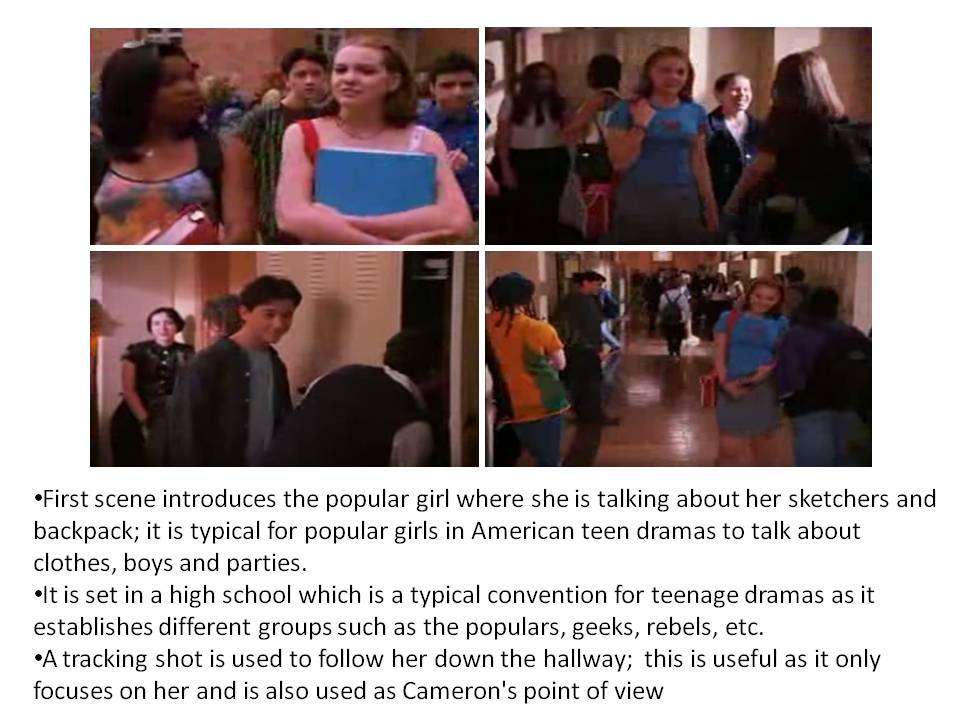
Deconstruction of "10 Things I Hate About You"


Codes and Conventions of Teen Films

Character Types / Groups
Most teen films are set in schools or universities were groups form based on personality and common interest. These groups do not mix with each other, which is often one of the main causes of conflict in the films. There is a hierarchy for these groups also which are used to create storylines. Examples of these groups are:

  • Nerds
  • Popular girls
  • Popular boys (often dating the popular girls)
  • Goths
  • Arty people
  • Some groups are often based on nationality
Locations
As previously mentioned, most teen films are set in schools or universities. And there are often house parties. But as they are 'teen' films, they are usually set in schools to create a sense of personal identity for the audience

Narrative
Most teen films follow Todorov's narrative theory which starts with equilibrium and then the teens have trouble which the audience can relate to ie. bullying, not fitting in, boy troubles (Personal Identity) and then it is resolved and the film returns to calm and normal (New Equilibrium)

Camera and Lighting
Most teen films use a lot of close ups and shot reverse shot to shot the characters face and conversation. The shots are usually quite bright as they are set in a school.

Deconstruction of Juno trailer and poster

Poster


Juno is a comedy film which addresses modern taboos in society, such as teenage pregnancy and adoption.
Main image
  • Two teenagers
    • male is scratching head - represented as
    • female - young, pregnant, serious, direct eye contact with camera
  • Stripy orange and white background - fun, less serious
    • Orange - happiness, youth, health, determination
    • White -  light, goodness, innocence, purity, and virginity - irony
Typography
  • Sketchy green - growth, harmony, freshness, and fertility. Green has strong emotional correspondence with safety.
  • Cartoon like font adds a less serious side to the poster to indicate its adding humour to a serious topic.
Tagline
  •  A comedy about growing up...and the bumps along the way
  • Comedy
  • "growing up" - teenagers
  • "bumps" - pun
Golden Rule
  • Main image on left - eyes drawn to this and led across to the title

Trailer


  • Awards the film has won - gives importance and credit to the film for winning two awards

  • Close up of young girls face - teenager, already know she is main character from her wing in the opening of the trailer 
  • Linking Juno with another film helps capture a similar target audience to the film previously directed but the same person. Orange and White striped background and font match poster house style
  • Production company in pregnancy test - genre and moral panic - teenage pregnancy is quite a taboo subject worldwide and having the 'FOX Searchlight Pictures' logo in the pregnancy test makes the genre and main theme of the film immediately evident
  • Again, being a taboo subject, teenage pregnancy is not often discussed in a casual and humorous way, unlike in this scene the shop worker makes jokes about the positive pregnancy test

  • Embarrassing middle aged parents - announces to her parents she is pregnant, they react in a comical way dissimilar to real life

  • Adoptive parents - another taboo - although subverts to media representation of teenage pregnancy as Juno makes a big decision to create the best future for her unplanned baby


  • Upper/working class contrast - location, dialect, formality, dress - all very different


  • House style again with font and background
I like how the poster and trailer use the same colour scheme and typography which ensure the same house style is incorporated across all of the promotional material.
The genre in the trailer and poster is clear due to the quirky colours and comical appearance of both characters.

Saturday, 19 September 2015

Moral Panic: Teenage Crime

Moral Panic

Moral panic is when the feeling of anxiety is expressed in a population, which could be locally, nationally or internationally. Moral panic usually occurs when there is an issue that threatens current society - for example the recession.
Moral panic is caused by an increase in negative media coverage. This usually happens when there has been a recent issue, and other past case studies are used to highlight the problem. It allows a large amount of people to hear about the information and pass it on - causing moral panic.

These are a few headlines from various news websites like the Telegraph, Daily Mail and the Huffington Post from either 2014 or 2015.

The moral panic related to teenagers can be reduced by not using demonising labels in newspaper articles i.e. Frenzied and Stab Death.
Although for these headlines to exist the crimes must be happening. To stop moral panic focusing on teenage crimes, headlines and articles could be published on parts of the site that get smaller interest, or controversially not published at all, which is what happened with the Stephen Lawrence trial.

The telegraph posted an article stating that are psychological reasons for certain teenagers to turn to crime. The headline being "Poor boys turned into criminals at school". The article later defined poor boys as "white boys eligible for free school meals".
In poorer regions of the United Kingdom, teachers are more likely to be less qualified at their jobs, with one teacher stating that "proper discipline belonged in the dark age".  Leading to students becoming less interested in learning and turning to other activities such as drinking and crime.
Even statistically the increase in moral panic over teenage crime doesn't make sense. The first graph shows that the number of guilty 18 to 20 year olds has decreased from 60,000 in 1999 to 45,000 in 10 years. 

The second graph shows that the number of arrests between the ages of 10 and 17 has reduced from 500 per 100,000 to less than 200 per 100,00 from 1992 to 2012.

Creating a public anxiety over an issue is a way of keeping the public safe, as it stops people becoming careless with their safety. By scaring the public, they are more likely to stay away from potentially dangerous places.
Another reason could also be to scare younger generations. By exposing them to teenagers with prison sentences, they are less likely to follow the same path and commit crimes. Although the increase in demonising labels aimed at teenagers, that aren't always true, make teenagers more likely to conform to the self-fulfilling prophecy.