Showing posts with label CHE. Show all posts

Thursday, 4 February 2016

Narrative Theories

  • Bordwell and Thompson (1980) state that narrative is defined as “a chain of events in a cause-effect relationship occurring in time”. American screenwriter, Syd Field suggests a good film must, in the first ten minutes, engage the target audience whilst introducing the genre and narrative.  In our group, we have conformed to this theory in just a small fraction of this time to create a successful sixty second teaser trailer using restricted narration to force enigmas and offer minimal information about the urban teen drama film through mise-en-scene such as drugs and cigarettes but enough to engage our target audience. By using subjective character identification we have given the audience a view into the main characters life from the outside – creating further enigma towards the cause of her being alone.  


  •  Vladimir Propp’ Theory of Narrative suggests the narrative “spheres of action” apply to most films. This theory introduces seven character types; hero, villain, donor, helper, princess, dispatcher and false hero. From out teaser trailer, the audience can assume the main character, Rose, plays the part of the princess and the villain due to her underlying battles with depression and isolation highlighted in the titles.  From these titles the audience can tell Rose is her own villain as she is a victim of her own self-destructive mind and chooses to take harmful drugs seen in shots of her injecting heroin- this also makes her the princess. As our film is a social realist film, Rose being two opposite character types conforms to real life situations where realistically, there is not always a hero character and there is not always a happy ending which we have highlighted in our trailer by closing the trailer with an enigmatic shot of Rose wearing old, dirty clothes outside.

  • Aristotle studied the narrative of plays and found that the narrative should be created within a ‘unity of time’. With the entire plot based in the same location in real time with all action leading towards a conclusion. Our trailer subverts this idea as it shows a number of different locations and times without conclusion. Continuous montage of footage shows jump cuts between different locations including a flashback and unresolved issues including homelessness.
  • Todorov presented a theory of narrative that suggests five stages of narrative in mainstream films; equilibrium, disruption, recognition, repaid and new equilibrium. Our film however subverts this idea as the trailer opens with the upmost point of disequilibrium with close up shots of cooking and injecting heroin as well as ending the trailer with a fast mid shot of Rose sitting alone outside, homeless.  This creates further enigma as the first stage or equilibrium and how disruption occurred are not clear.


  • Allan Cameron’s Modular Narrative’s “articulate a sense of time as divisible and subject to manipulation”. Of the four types of modular narrative; anachronic, forking paths, episodic and split screens – our trailer has an anachronic narrative, as there is no clear dominance between and of the narrative threads. Our character has physical flashbacks near the end of the trailer, which show her life before she turned to drugs. This flashback cements the narrative to show calm and happiness before she became an adult. The flashbacks are also the only time you see Rose with other people, which highlights her isolation in real time.
  • Levi-Strauss’ Binary Oppositions theory states that narrative tension is based on opposition or conflict. Our trailer conforms to this theory as Rose is in conflict with herself. Her drug and alcohol abuse shown in he trailer along with evidence of depression shows her inner turmoil and conflict with her own mind and habits. There is also a transition and clear opposition between her current situation and her past where she was much happier shown through mid shots of her laughing with friends in comparison to mid shots of her in real time alone and isolated with nobody around her.


Thursday, 28 January 2016

Photoshop Work for the Poster

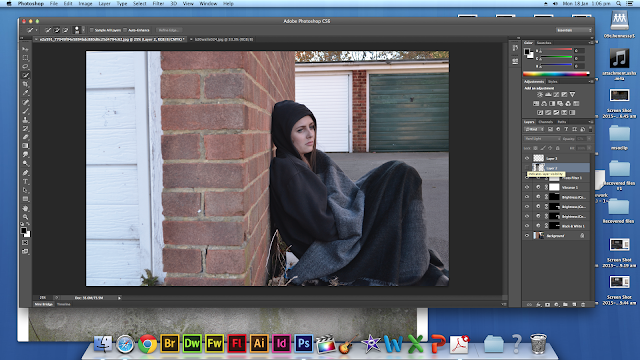
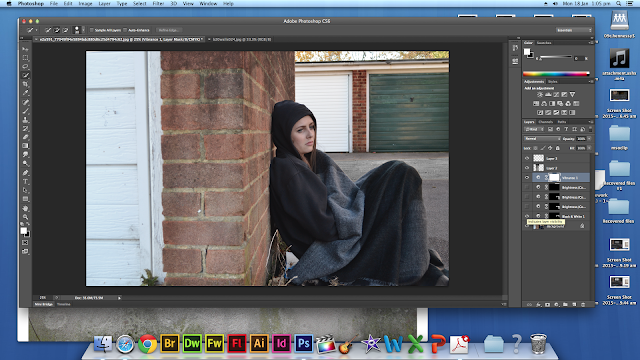
I edited the image above to make it more appropriate to use on our website. I started by rotating the image 2 degrees counter clockwise so that the wall was straight in the frame (see below)

I then had to crop the image so the white border wasn't visible and the straightened image filled the frame. I did this by using the rectangular marquee tool (dotted line around the image in the screenshot above), I then selected Image > Crop and ended with the result in the image below.
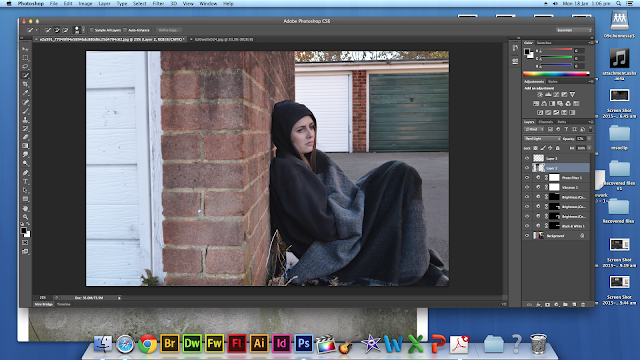
I selected the area of ground that was lit up by the sun and edited this area to make it the same colour as the rest of the ground so the image wasn't as bright and it looked more negative. I did this by making the area black and white and then altering the brightness and feathering the selection to blend the colours of the ground together.
I then added a 'worn wall' image from the internet and set the layer mode to Hard Light do that the gradual faded dark area of the layer blended into the walls. I applies this to all the walls so that they looked worn and dirty. As the walls were previously too clean and new.
I then altered the image as a whole by decreasing the saturation and contrast to give the image a darker and less positive look. I also darkened the sky to make it look like cold evening lighting. To finish off, I used the stamp and spot healing tool to duplicate areas of the image to cover the folder she's sitting on and the plants around the doors.

This final edited image looks much more appropriate for genre than the original due to its dark and low-saturation look. I like the gradient on the wall and how the image looks less like daytime and the darkness of it makes it look a lot colder and will evoke sympathy fro the audience as the character in the frame looks cold and vulnerable.


Sunday, 8 November 2015

Lighting Test: Fire

One of our scenes in our trailer will show Rose - our main character - sitting around a fire with her friends before her life takes a bad turn. I therefore tested and altered the lighting around the fire during filming to improve the lighting as we filmed.
We may also use the photos from the lighting test for Rose's fake Instagram page.

Before: This photo is lit only by the fire. It is very dark, even though the videos come out lighter but less grainy.
 After: I turned on the security light and it made the image brighter and cast shadows on the face however the orange tint from the fire was still visible.

We added fire lighters and newspaper to increase the size of the fire to improve the brightness. This image is lit by just the fire and security light however the fire was brighter so more visible than the artificial bulb lighting

The shots during this scene were a lot brighter and were successful. We will review the footage and add the best shots to the timeline on FinalCut.

Wednesday, 4 November 2015

Deconstruction of mise-en-scene in Trainspotting

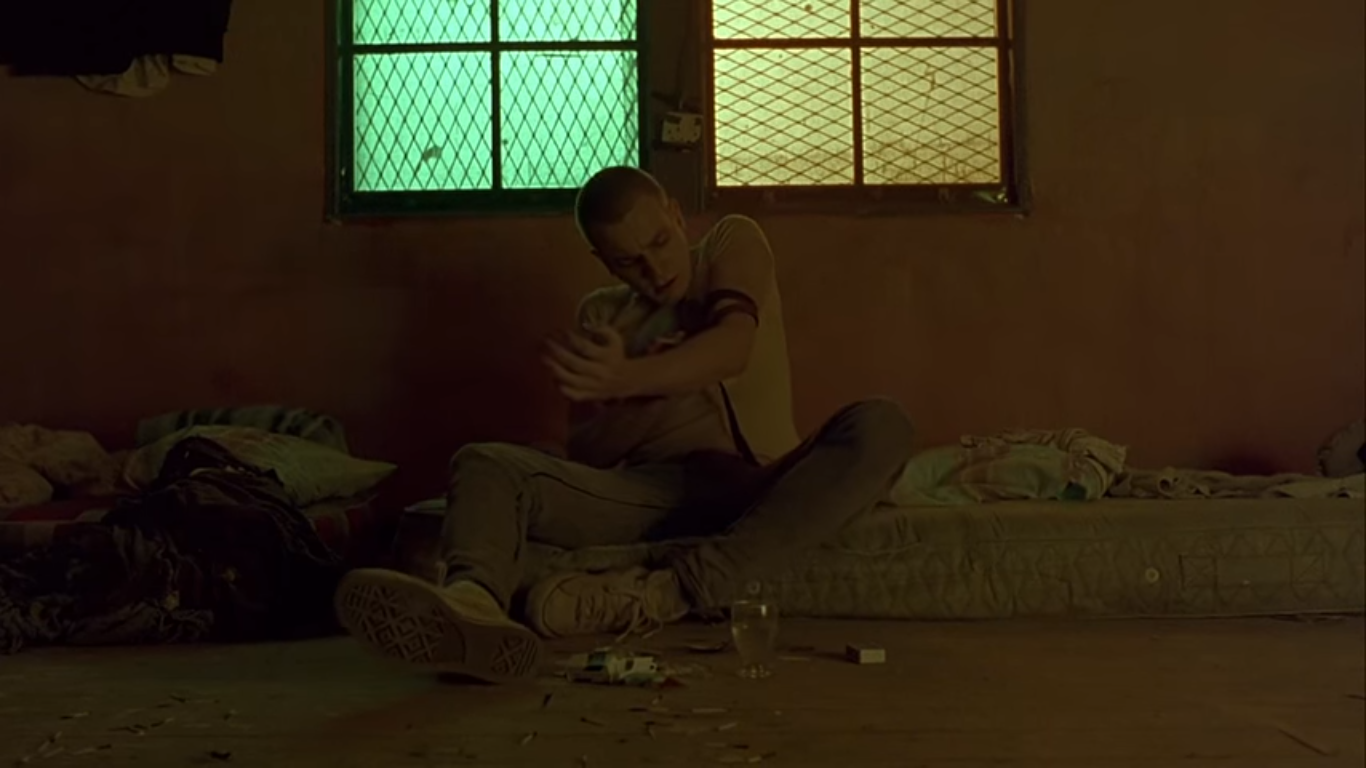
Trainspotting is an iconic British film known for it's storyline based around drug use in Glasgow in the 1990's. As a lot of our film idea is based around drug addiction, I decided to use Trainspotting for mise-en-scene inspiration to make our drug scenes look as convincing as possible.

Here the character is seen lying on he floor with the needle still in his arm and the spoon and lighter beside him. This shows the calming effect of the drug as the user looks sleepy and he gently falls back while exhaling, showing the drug takes an immediate effect.

This shot shows a deal taking place with the character on the right sliding money across the counter and the "dealer" on the left sliding a small pill across in exchange. The low key lighting is ideal for a drug dealing area in order to keep it secretive and private. 
 A close up of the diluted and melted heroin being pulled into the syringe from a dirty spoon is effective as it shows the detail of the use whilst showing the dull, dirty environment with low saturation which reflects the world in which the users live in. The heroin is like a lumpy liquid where the powder is diluted in water.
 A long shot shows the character sitting whilst injecting himself with the heroin. He has a belt tied around his upper arm which makes the veins more visible and accessible for the needle while he injects the drug.
 This mid shot shows the dealer from a previous scene heating the heroin on a metal spoon with a regular lighter. Showing the basics of preparing the drug and reflecting the little they have which is why they turn to drugs as a form of diversion from issues in society such as unemployment.
 This high angle close up shows the heroin bubbling in the spoon as it is heated. We have a shot very similar to this to show the preparatory process.
A mid shot with a shallow depth of field focuses only on the pills in the characters hand, which draws the audiences attention to this as the camera tilts up and focus pull is used to change focus to the characters face. 
 A fisheye like lens s used to distort and curve the image which the user sees to show the effects on his vision as he walks though a betting shop as people stare.
The dealer holds out a full needle as the character reaches out about to use the syringe, he again has a belt around his upper arm.
A close up shows the needle entering the vein, we obviously cannot achieve this however will try to create the illusion of the needle entering the skin.

Saturday, 31 October 2015

Practical: Fake Cigarettes

As our main actress does not smoke and would prefer not to smoke a real cigarette during the trailer filming, I have decided to make a fake cigarette to create the illusion that the actress is smoking.

I used:

  • Cigarette Paper
  • Kitchen Paper
  • Dried Parsley
I first cut the kitchen paper to the length of the cigarette paper and folded it in half, then sprinkled the dried parsley into the kitchen paper.
I then rolled the kitchen paper around the parsley until it was small enough to have the cigarette paper wrapped around it. This part was quite difficult to do as I had to keep the paper tight or the cigarette paper would not fit around it.
Evaluation

What went well?
  • The cigarettes were very simple to make
  • The final outcome was successful as they looked very convincing
  • The model could smoke in the scenes without using real cigarettes which she was not comfortable with
  • I also asked a smoker for an empty cigarette box to store the fake ones in to make the, look more convincing and the cigarette packet could be used in our shots


How could they be improved?
  • Verity didn't particularly like the taste of the cigarette
  • They were quite hard to light and did not stay lit for all the shots
Overall, I think the fake cigarettes were successful as they looked convincing and looked exactly how we wanted them to.